


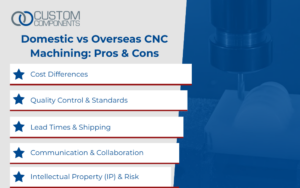
Choosing between domestic and overseas CNC machining is a strategic decision that directly impacts cost, quality, and operational efficiency. Companies like American Micro Industries understand that the right approach isn’t optional—it’s essential for staying competitive. Domestic sourcing delivers control, speed, and consistency, while overseas production offers cost advantages at scale. Both options have clear strengths, but each also introduces specific risks. Ignoring those tradeoffs leads to delays, defects, and unnecessary expenses. A disciplined evaluation ensures your CNC machining strategy supports both performance and profitability.
Overseas CNC machining consistently delivers lower production costs through lower labor rates and operating expenses. Countries like China, India, and Vietnam make high-volume manufacturing far more affordable, which is critical for cost-sensitive projects. This advantage becomes even more significant as order quantities increase. Businesses focused on scaling production often rely on overseas partners to maintain competitive pricing. The cost savings are real and can improve margins when managed correctly. For large production runs, overseas sourcing is often the most economical choice.
Domestic CNC machining comes with higher costs, driven by labor, compliance, and operational standards. These expenses are unavoidable and must be factored into any sourcing decision. While the price point is higher, it reflects tighter quality control and greater accountability. Businesses must determine whether the added cost aligns with their performance expectations. For high-volume, low-margin projects, domestic sourcing may not be practical. Cost discipline requires a clear understanding of where domestic manufacturing adds value.
Overseas CNC machining is not as inexpensive as it first appears when total costs are considered. Shipping, tariffs, and customs fees quickly reduce the initial savings. Quality issues can force rework, adding time and expense. Communication gaps may also lead to costly errors if not closely managed. A narrow focus on unit price leads to poor decisions. Evaluating total cost is the only reliable way to compare domestic and overseas CNC machining.
Domestic CNC machining provides consistent, verifiable quality backed by strict standards and certifications. Businesses can audit processes, inspect facilities, and maintain direct oversight. This level of transparency eliminates uncertainty and reduces risk. Manufacturers are held accountable to clearly defined expectations. For industries with tight tolerances, this control is non-negotiable. Reliable quality is a direct outcome of disciplined domestic production.
Quality inconsistency is a real risk with overseas CNC machining if suppliers are not carefully vetted. Standards may vary, and communication gaps can lead to parts that fail to meet specifications. Issues are often discovered after delivery, creating delays and additional costs. Without strong oversight, defects become more likely. While capable suppliers exist, reliability cannot be guaranteed. Businesses that ignore this risk pay for it later.
Overseas CNC machining can meet high-quality standards, but only with strict supplier selection and clear expectations. This requires time, due diligence, and ongoing management. Domestic providers simplify quality assurance, while overseas partners demand more oversight. The tradeoff is straightforward: lower cost versus higher management effort.
Domestic CNC machining delivers faster turnaround times and greater operational flexibility. Without international shipping, production cycles are shorter and more predictable. Businesses can respond quickly to changes, urgent orders, or market demands. This speed provides a measurable competitive advantage. Delays are minimized, and timelines are easier to control. When timing matters, domestic sourcing is the clear choice.
Overseas CNC machining introduces extended lead times due to shipping and customs processes. Ocean freight alone can add weeks, and port delays can push timelines even further. Documentation and clearance requirements create additional friction. These delays are not exceptions—they are part of the process. Businesses must plan accordingly or risk disruptions. For time-sensitive projects, overseas sourcing creates avoidable complications.
Global supply chain disruptions make overseas CNC machining inherently less predictable. Port congestion, geopolitical issues, and transportation delays can all impact delivery. These risks are outside your control and difficult to mitigate. Domestic production offers greater stability and consistency. Businesses that prioritize reliability cannot ignore this difference. Predictability is a critical advantage.
Domestic CNC machining enables direct, real-time communication, keeping projects on track. Shared time zones and language eliminate unnecessary friction. Engineering teams can collaborate efficiently and resolve issues without delay. Design changes are implemented quickly and accurately. This level of alignment reduces errors and improves outcomes. Strong communication is a key driver of successful production.
Overseas CNC machining introduces communication barriers that slow progress and increase risk. Time zone differences delay responses and decision-making. Language gaps can lead to misinterpretation of technical details. Cultural differences may also affect expectations and workflows. These challenges require active management. Without it, errors become more likely.
Communication directly affects quality, especially for complex or custom components. Small errors in interpretation can lead to major production issues. Domestic CNC machining reduces this risk through consistent collaboration. Overseas partnerships demand structured communication and precise documentation. Businesses must invest time to maintain alignment. Complexity increases the importance of communication discipline.
Domestic CNC machining provides strong intellectual property protection under established legal frameworks. This safeguards proprietary designs and reduces exposure to theft. Legal enforcement is clear and accessible if issues arise. Businesses retain control over their innovations. For competitive industries, this protection is essential. Security is a decisive advantage of domestic sourcing.
IP protection is less consistent across international markets, creating additional risk. Enforcing agreements abroad is often difficult and time-consuming. This increases the likelihood of unauthorized use or replication. Businesses must rely heavily on contracts and trust. The risk is real and must be acknowledged. Ignoring it can compromise competitive advantage.
Protecting intellectual property must be a priority, especially for innovative products. Domestic CNC machining offers a more secure environment. Overseas sourcing can still be viable, but only with strict legal protections and trusted partners. Businesses must assess the value of their designs before making a decision. Risk tolerance should drive the strategy. Compromising IP security is rarely justified.
Domestic and overseas CNC machining each serve a clear purpose, but the choice must be deliberate. Domestic sourcing ensures speed, control, and consistent quality, while overseas production reduces costs for high-volume manufacturing. The right decision depends on your priorities, but it must be grounded in a thorough understanding of costs, risks, and performance. Companies like American Micro Industries help businesses make these decisions with clarity and confidence.
Take control of your CNC machining strategy now. Partner with experts who can deliver the right balance of cost, quality, and reliability—and position your business for long-term success. Contact American Micro Industries today to discuss your project and take the next step toward smarter, more reliable manufacturing.
American Micro Industries supports clients across manufacturing, automotive, aerospace, military contracting, and other industries. From bulk electrical insulation and sound deadening materials to in-house CNC machining, die cutting, laser cutting, plastic machining, and more, our team can help you find the right solution for your project.